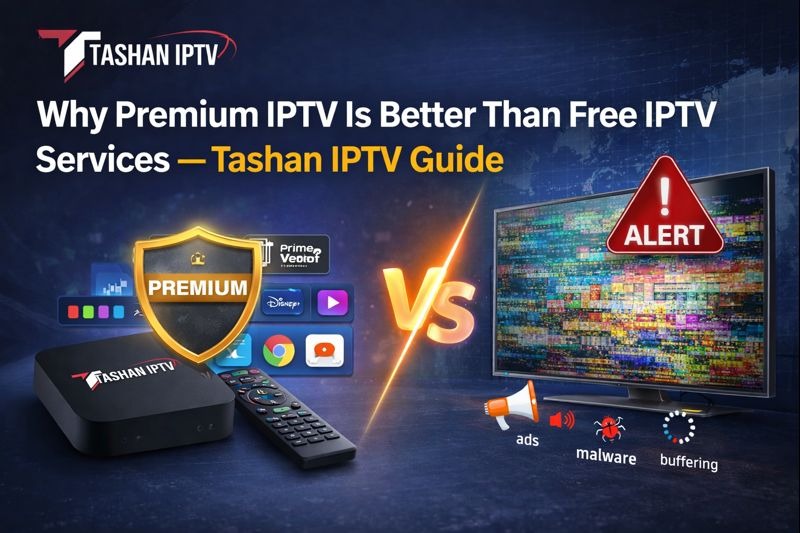
Why Premium IPTV Is Better Than Free IPTV Services — Tashan IPTV Guide
A lot of people first try IPTV with free links they find on the internet. At the start it feels nice. Many channels, no money, easy to start. But after some days, problems begin. Channels stop working, picture keeps freezing, and big matches cut in the middle. That is when you start thinking about premium iptv and if it is really worth paying for.
This guide explains, in simple words, why paid IPTV is usually better than free IPTV. We will also talk about how a service like Tashan IPTV shows the difference in real life. No hard tech talk, just clear points you can understand.
What Is IPTV in Simple Words
IPTV just means “TV over the internet.” Instead of using a cable wire in your wall or a big dish on your roof, the TV channels come to you through your internet line.
You open an app or a player, choose a channel or a movie, and it starts playing on your screen. You can use a smart TV, a TV box, a phone, a tablet, or even a laptop. As long as the internet is okay, the TV works.
So IPTV is not magic. It is just TV that travels through the internet instead of old cable or satellite.
What Is Premium IPTV?
Now, what does premium iptv even mean? Premium here is simple. It means you pay for it, and you expect better quality in return.
A paid iptv service will try to give you:
stronger servers so channels do not crash all the time
- better picture and sound
- more channels that actually work
- some type of help if you get stuck
Free IPTV does not promise any of this. If it works, it works. If it breaks, you are on your own. That is the big difference.
Free IPTV vs Premium IPTV: Main Differences
| Feature | Free IPTV | Premium IPTV (Tashan IPTV) |
| Cost | Free | Paid subscription |
| Server Reliability | Weak or overloaded servers, leading to interruptions | Strong servers, minimal downtime |
| Link Maintenance | Links are shared and may die or stop working | Regular updates and maintenance of channels |
| Support | No customer support | Dedicated support team available 24/7 |
| Quality of Streams | Variable, often low-quality or buffering issues | High-quality, consistent streams |
| Time Spent | High, due to hunting for working links | Low, as service is reliable and ready to go |
| User Experience | Frustrating, with frequent interruptions | Smooth, uninterrupted streaming with minimal hassle |
| Access to Content | Limited channels and frequent dead links | Wide range of channels, always available |
| Service Updates | No regular updates or improvements | Continuous service improvement and updates |
Why Premium IPTV Is Better for Daily Use
If you watch TV once a month, maybe free links are enough for you. But for daily use, premium iptv is usually much better.
Streams Are More Stable
No one likes buffering. When the video stops every few seconds to load, you cannot enjoy anything. This happens a lot with free IPTV because of weak servers or too many people on the same link.
Paid services usually have better servers. When your own internet is okay, the stream should play smooth most of the time. Tashan IPTV, for example, focuses on keeping live channels steady during busy hours.
Better Picture and Sound
On free IPTV, many channels look blurry or low quality. Some are in such low resolution that watching on a big screen hurts your eyes.
Premium IPTV often gives you HD and sometimes even 4K on some channels. The sound is cleaner too. This makes a big difference when you watch movies, sports, or nature shows on a larger TV.
Channels Actually Work
Free lists often show a lot of channels, but when you click, half of them are dead or stop after one minute. It feels like a fake big list.
With a reliable iptv service, the goal is to have fewer broken channels. Of course, sometimes a channel will have trouble, but the provider will try to fix it or swap it with a new one. Tashan IPTV and other serious providers spend time keeping the lists alive.
You Can Get Help
When a free link breaks, you cannot call anyone. There is usually no support. You just search again and again.
With a paid iptv service, you can at least send a message or email. Support may not be perfect, but having someone to ask is much better than guessing alone. For people who are not very good with tech, this is very important.
How Tashan IPTV Shows the Power of Premium IPTV
Tashan IPTV is a good example of how premium iptv works in real life. Many families use it as their main TV, not just as an extra.
In one house, parents might watch news or dramas, kids might watch cartoons, and someone else might follow live sports. With a strong service, all of this can happen at the same time, on different screens, if the internet speed is good.
You do not have to keep searching for new free links every weekend. You open the app, pick a channel, and it just works. This is what people mean when they say “reliable iptv service.” It is not perfect, but it is good enough that you can relax and watch.
When Does It Make Sense to Switch to Premium?
You might be asking yourself, “Do I really need to pay?” It depends on how you use TV.
Premium IPTV makes the most sense if:
- you watch TV or sports almost every day
- you want your family to use it without breaking it all the time
- you get very angry when streams die in the middle of live games
- you are tired of wasting time on new free links
If these sound like you, then paying for a stable service is more like buying peace of mind. You pay some money, but you save your time and your mood.
How to Choose a Good Premium IPTV Service
Not every paid service is good. Some are just as bad as free ones, only they take your money too. So you should be careful.
Look for services that have been around for more than a few months. See if real people talk about them, not just fake reviews. Check if they answer questions and give support. Try a short plan first, not a very long one, so you can test it.
A good paid iptv service should be open about what they offer. You should know how to contact them, and what devices they support. If everything is secret and only done through one chat, be careful.
Services like Tashan IPTV built their name slowly over time. This is usually a better sign than a new service that promises the world on day one.
Final Thoughts
In the end, the fight of free iptv vs premium iptv is really about what you want. If you just want to play around and do not care if things break, free IPTV might be enough for you.
But if you want TV you can trust every day, for your family and for big games, then premium iptv is much better. A good reliable iptv service, like Tashan IPTV, gives you stable streams, better quality, working channels, and some kind of support when you need help.
You pay money, yes. But you get back something important: simple, easy TV without the constant stress of broken links and ugly buffering circles.